


Paper.io 2
VOODOO
I went into Paper.io 2 expecting a quick arcade distraction, and that is exactly where it works best. It is a territory-capturing game from VOODOO in which I guide a small moving shape beyond its existing area, draw an enclosed route, and try to claim more space before an opponent interrupts me. The idea is easy to understand within seconds, but the simple controls hide a surprisingly tense risk-and-reward loop.
My first impression was that each round feels more like a short challenge than a traditional arcade campaign. There is no long tutorial to study and no complicated control scheme to memorize. I can begin almost immediately, make a bold move, lose everything through one careless turn, and try again. That instant restart rhythm is a major reason the game is so easy to pick up during a spare moment.
The game is free to download and is rated for Everyone, so it is approachable for a broad audience. Its popularity is substantial, with over 100 million installs and an average rating of 4.1 from around 2.4 million ratings. Those figures do not guarantee that every player will enjoy it, but they do reflect how well its compact arcade formula travels across different kinds of mobile players.
Getting started without turning a small problem into a big one
What the first few rounds actually teach
The opening matches are best treated as practice for movement rather than a test of ambition. The most important lesson is that leaving your claimed territory creates exposure. While the shape is outside its own area, the trail becomes a vulnerability. A rival can cut across it, or I can make a turn that leaves the route too open to defend.
I found it more useful to begin with short expansions instead of immediately attempting a huge section of the map. A small loop gives me a safer way to learn how quickly the character turns and how much space I can realistically close. Once that movement feels predictable, longer routes become a deliberate choice instead of a guess.
Related News

Why WhatsApp Messenger Still Makes Everyday Communication Feel Easy

Jurassic World: The Game Is the Better Dino Tycoon for Strategic Players

Threads in Real Life: Who Should Join, Lurk, or Leave

How SHEIN Turned Shopping Into an Endless Content Feed

How to Make Fortnite Feel Smarter on Mobile

Should You Switch to Microsoft Outlook on Mobile?
The controls look minimal, but that does not mean every input is equally comfortable. Small directional changes matter when I am close to an opponent or trying to connect with an edge of my territory. On a phone, finger placement can also hide part of the action, so I prefer to keep my hand relaxed and avoid making frantic swipes. A calm, early turn is usually more useful than a late correction.
Simple setup checks before blaming the game
Because this is a fast arcade title, setup friction can be especially annoying. If the game feels unresponsive, I first check whether the phone is already struggling with several open apps. Closing unnecessary apps and reopening the game is a sensible first step, particularly if movement began feeling delayed after the phone had been in use for a long time.
I also check that the device is running at least Android 8.0 when using the Android version. That requirement is easy to overlook when installing on an older phone. If the game installs but behaves unusually, restarting the device and making sure the operating system is current can separate a temporary phone issue from a problem inside the game itself.
Gallery
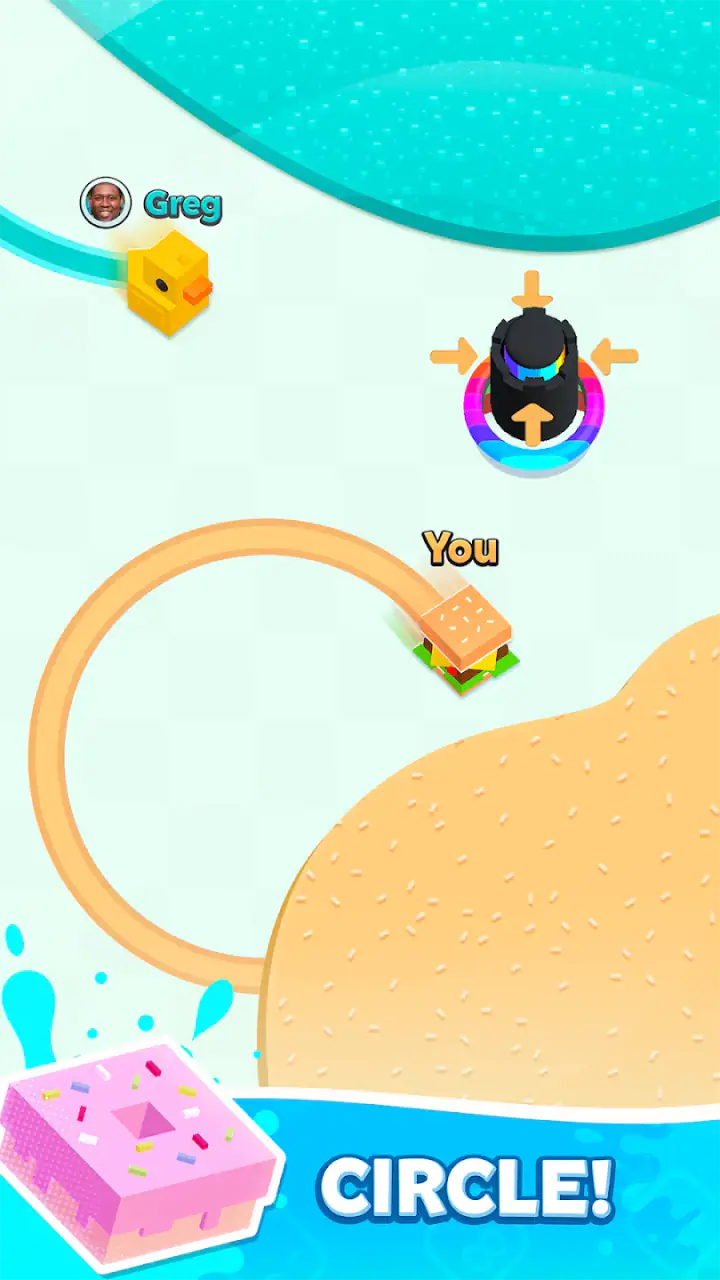
Another practical check is touch input. I remove anything that makes the screen difficult to read or touch accurately, such as a badly positioned protector or a damp screen. This matters more here than in a turn-based game because a tiny missed gesture can end a run. Testing a few controlled turns at the start of a match is a quick way to tell whether the issue is the game or the screen.
The current version is 4.24.1, so I would also make sure the installed copy is up to date through the normal app store process. Updates can resolve compatibility problems, but they can also leave a temporary download or installation issue. If an update appears stuck, I would restart the phone, check available storage, and try again rather than repeatedly tapping the install button.
Recovering a bad run and a bad session
There are two kinds of recovery in this game. The first is tactical: recovering from a risky expansion without losing the round. When I am far from my territory, I stop thinking about gaining the maximum possible area and focus on returning through the safest available line. A modest completed shape is better than a spectacular unfinished one.
The second is technical: recovering when the game stops responding, closes unexpectedly, or does not behave normally after returning from another app. I close and relaunch it before trying more disruptive steps. If the problem appears only once, I treat it as a temporary session failure. If it happens repeatedly, I check the operating system, storage, and connection conditions before considering a reinstall.
Reinstalling should not be the first reaction to a single failed round. It can remove local app data, and a casual arcade game is not necessarily the right place to assume that every progress detail will return automatically. I would use it only after simpler steps have failed and only after deciding that losing local progress is acceptable.
When the game appears frozen during a match, waiting briefly can be more sensible than immediately tapping the screen repeatedly. Repeated input may make it harder to tell whether the touch was registered. If the application remains stuck, force-closing it and starting a fresh session is a cleaner recovery path than continuing to fight an unresponsive screen.
How I manage the map instead of chasing every opening
The strongest practical improvement I made was to stop treating every visible gap as an invitation. The safest expansion is often the one that leaves me with a short route home and fewer directions from which an opponent can approach. I watch the distance from my territory, the angle of my return, and whether another player is already moving toward the same space.
A useful habit is to vary the size of each attempt. Several small captures can build a stable base, while an occasional larger move creates progress when the surrounding area is quiet. Repeating only large moves makes losses feel random, but switching between conservative and aggressive routes gives the round a clearer rhythm.
I also avoid turning too sharply near the edge of a completed area unless I know exactly where the route will reconnect. The game rewards visual planning more than speed. Looking one move ahead is often enough: where will the trail be, which side is exposed, and how quickly can I return? That small mental checklist prevents many avoidable failures.
For a realistic everyday use case, this works well during a short wait for a bus or while taking a break between tasks. I can play one or two rounds without needing to remember a complicated story or rebuild a large setup. The downside is that the same immediacy can encourage “one more attempt” behavior after a frustrating loss. I have to decide in advance whether I have time for a quick round or whether the game is likely to keep me longer than planned.
When the app is not the real cause of the trouble
Not every interruption comes from the game. A phone that is nearly full, overheated, or busy with background processes can make any fast touch-based title feel unreliable. If other apps also lag, the sensible response is to address the device rather than repeatedly reinstall this one.
Connection conditions can also affect the experience, especially when a session depends on communication beyond the immediate screen. If a round behaves differently on a stable connection than it does in a weak one, I compare those situations before deciding that the application is broken. Switching between networks, moving to a stronger signal, or restarting the connection can provide a useful diagnosis.
Battery-saving modes are another possible source of odd behavior on some phones. They may limit background activity or alter performance, and a game that depends on quick visual response can feel less consistent under heavy power restrictions. I would test the game under normal battery conditions before making a firm judgment about its controls.
Notifications and interruptions deserve attention too. A call, message, or system overlay at the wrong moment can break concentration and turn a safe route into a failed one. For a focused session, I prefer to silence avoidable interruptions. That is not a special requirement of this title, but its short reaction windows make interruptions more costly than they would be in a slower puzzle game.
Where it sits among other arcade choices
Compared with endless runners, this game gives me more control over the shape of my progress. I am not simply avoiding obstacles while the screen moves forward; I am choosing how much territory to risk and when to return. Compared with conventional puzzle games, it is less about solving a fixed board and more about reading a changing situation in real time.
That difference helps explain both its appeal and its limits. If I want a calm game with predictable rules and time to consider every move, a turn-based puzzle would be a better choice. If I want a deeper arcade system with extensive upgrades, a campaign, or a large collection of modes, this compact territory format may feel too narrow. Its strength is the short, repeatable contest, not long-term complexity.
The game is also more suitable for players who enjoy learning through failure than for anyone who dislikes losing progress instantly. A cautious player can improve by making smaller claims, but the central tension never disappears. The title is built around leaving safety, and players who find that kind of pressure irritating may prefer a game where mistakes can be undone.
Free access, spending, and the overall feel
The game is free, with in-app purchases ranging from $0.84 to $49.99 per item. I would approach those purchases carefully and decide whether the basic arcade loop is enjoyable before spending anything. The core reason to play is the territory challenge itself, so buying something should not be treated as a substitute for learning safer routes or improving control.
Its Everyone rating makes it a reasonable option for families looking for a straightforward arcade game, although adults may still want to review how spending is handled on a shared device. The most useful household habit is to keep purchase controls managed at the device or account level, especially when children can access free-to-play games.
VOODOO’s design here is intentionally immediate: open the game, understand the objective, and attempt another round. That simplicity is a strength when I want something accessible, but it also means the experience can feel repetitive if I need constant novelty. I would recommend it as a snack-sized game rather than as the only game installed on a phone.
Who should install it, and who should skip it
I think it is a good fit for someone who likes quick arcade matches, visual territory control, and the satisfaction of improving through repeated attempts. It is especially appealing if you enjoy making decisions under pressure but do not want a long tutorial or a complicated character system.
I would be more cautious recommending it to players who need offline certainty, dislike free-to-play spending choices, or expect a substantial progression structure. It is also not my first suggestion for anyone with unreliable touch input, because precise turns are central to the experience. A larger-screen device may feel more comfortable than a cramped phone, but the underlying risk remains the same.
My most useful advice is to judge it after several short sessions rather than one lucky or unlucky round. Early failures can come from overextending, while an early success can hide how demanding the controls become when the map gets crowded. Give yourself time to learn the safe distance for an expansion, then decide whether that tension feels rewarding or merely stressful.
My practical verdict
Paper.io 2 succeeds because it turns a very small rule set into a constant series of meaningful choices. I like that a round can be understood instantly, yet careful players still discover better ways to approach the map. Short routes, controlled returns, and patience matter more than blindly claiming the largest visible area.
Its main weakness is also clear: the experience can become repetitive, and a single missed turn can erase a promising attempt. Technical friction from an older operating system, a busy phone, poor touch response, or an unstable connection can make that frustration worse, so basic setup checks are worth doing before judging the game.
My recommendation is simple: try it if you want a free, fast arcade game built around territorial risk. I would keep my sessions short, protect the device from accidental purchases, and treat every failed run as information about route planning rather than as proof that the game is unfair. For casual players who enjoy immediate competition and gradual control improvement, it is an easy game to return to. For players seeking deep progression, calm puzzle solving, or a more forgiving structure, another arcade option will probably be a better match.
After spending time with it, I see the appeal behind its broad reach: the rules are friendly, the action starts quickly, and improvement is visible from one attempt to the next. Just keep expectations in the right place. This is not a large adventure or a feature-heavy strategy game; it is a focused mobile contest that works best when I have a few minutes, a responsive screen, and the patience to make one safer decision than I made in the previous round.
FAQs for Paper.io 2
What is the main objective of Paper.io 2?
In Paper.io 2, the main objective is to conquer as much territory as possible by drawing lines and enclosing areas. Your goal is to expand your domain while avoiding getting hit by other players or running into your own trail. The game is an addictive blend of strategy and quick reflexes.
How does multiplayer work in Paper.io 2?
Paper.io 2 features a real-time multiplayer mode where you compete against players from around the world. The map is shared, and each player attempts to expand their territory while defending against others. It’s a competitive environment that requires strategic planning to outsmart opponents and survive.
Are there any in-app purchases or ads in Paper.io 2?
Yes, Paper.io 2 includes in-app purchases and ads. Players can buy ad-free experiences or unlock special skins. Ads can appear between games, which might disrupt the flow for some users. However, purchasing the ad-free version can enhance the gaming experience significantly.
What are some tips to succeed in Paper.io 2?
To succeed in Paper.io 2, prioritize securing small areas quickly and expanding gradually. Avoid making large loops as they expose you to attacks. Always keep an eye on other players' movements to anticipate their actions. Defensive play by staying close to your territory can also be a key strategy.
Is Paper.io 2 suitable for all age groups?
Paper.io 2 is generally suitable for all age groups due to its simple mechanics and non-violent gameplay. However, younger children might need guidance due to the competitive nature and the need for strategic thinking. It's a great game for developing quick decision-making skills.
Pros
- Simple controls make it easy to learn.
- Visually appealing with vibrant colors.
- Addictive gameplay keeps you engaged.
- Quick matches fit into any schedule.
- Smooth performance with minimal lag.
Cons
- Can become repetitive over time.
- Ads can disrupt the gaming experience.
- Limited customization options.
- Requires internet connection to play.
- Occasional server connectivity issues.


